Large invoices. Credit card payments. 3% gone on every transaction. For a shop billing $80,000 a month in card payments, that's $2,300 disappearing before it ever hits your account.
There's a legal, simple way to stop that. Here's what you need to know.

Parts costs are up. Labor is competitive. Customers want it done yesterday and dispute it tomorrow. You've optimized everything you can — your bay efficiency, your parts sourcing, your scheduling.
And then quietly, every single month, 2.5% to 3.5% of your card revenue walks out the door to a processor you barely think about.
On a shop doing $80,000 a month in card volume — not unusual for a busy auto or HVAC operation — that's $2,000 to $2,800 a month. Every month. $24,000 to $33,000 a year.
That's a technician. That's a service van. That's yours.
The higher the transaction, the more you save per job. A 3% fee on a $1,500 transmission job is $45. Multiply that across your monthly volume and the numbers add up fast.
Parts markups, shop supplies, diagnostic fees — your customers understand that running a shop has costs. A clearly disclosed card fee fits naturally into that context.
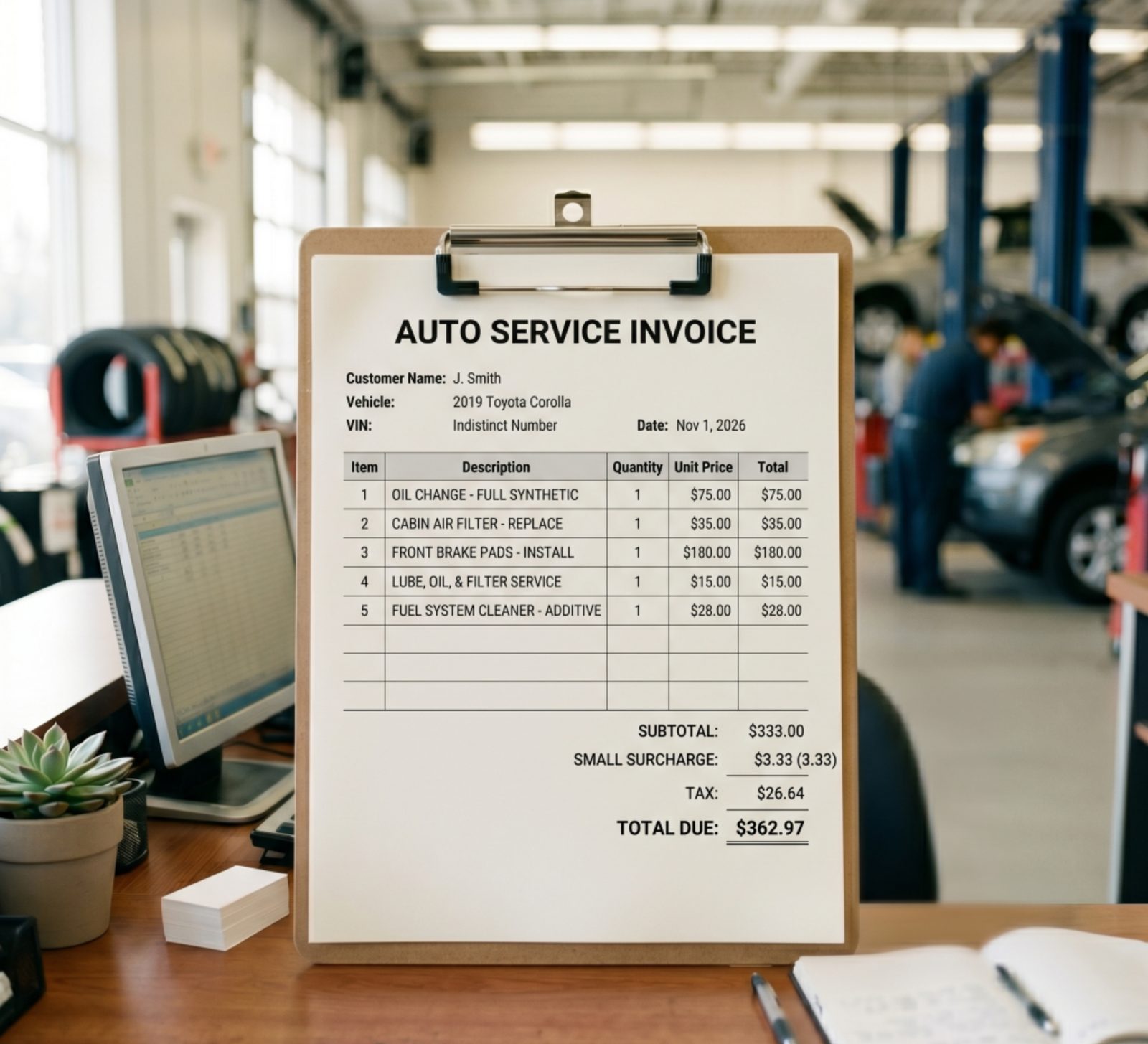
For HVAC and repair shops billing by invoice, surcharging integrates cleanly. The fee appears as a line item — transparent, professional, and compliant.
Many of your customers pay cash or check for smaller jobs anyway. Dual pricing gives cash customers a clear incentive and card customers a clear choice.
Not sure which fits your operation? That's exactly what our free analysis is for.
| Monthly Card Volume | Current Fees (at 2.9%) | Monthly Savings | Annual Savings |
|---|---|---|---|
| $30,000 | $870 | ~$827 | ~$9,920 |
| $60,000 | $1,740 | ~$1,653 | ~$19,830 |
| $80,000 | $2,320 | ~$2,204 | ~$26,450 |
| $120,000 | $3,480 | ~$3,306 | ~$39,670 |
Savings reflect ~95% recovery rate accounting for cash and check payments.
Some will ask about it. Very few will walk. Your customers chose you because they trust your work. A clearly explained card fee — especially on a $600 repair — is not going to cost you a loyal customer. The customers who push back hardest are usually the ones who would have paid cash anyway — which means dual pricing works in your favor either way.
Most modern shop management systems support surcharge line items or can be configured for dual pricing. We'll look at your current setup during the analysis and tell you exactly what's needed. In most cases it's simpler than you'd expect.
You won't. We handle the processor notification, the terminal configuration, and the signage. You focus on the shop. The compliance piece is our job.
Dual pricing is legal in all 50 states with no card network registration required. Surcharging requires a 30-day processor notification and cannot be applied to debit cards — both of which we handle as part of your setup. Every terminal we configure automatically detects whether a card is credit or debit and applies the correct pricing. This is non-negotiable under federal law and we don't cut corners on it.
FeeSlicers was founded by two payments industry veterans who built and sold a payment gateway. We've worked with service businesses across the country and we know how shops actually operate — the cash flow pressures, the seasonal swings, the customer dynamics. We're not going to oversell you on something that doesn't fit. When you reach out, you talk to George — a real person who will give you a straight answer and walk you through exactly what makes sense for your operation.
We were doing $95K a month in card volume and paying almost $2,800 in fees. George set us up with surcharging and it's been running clean for eight months. Customers barely blink.
I was skeptical because I'd heard about cash discount programs that got shops in trouble. George explained the difference and we went with dual pricing. Zero issues, significant savings.
Free analysis. Real numbers. No obligation. If it's not the right fit we'll tell you straight.
Ready to move forward?