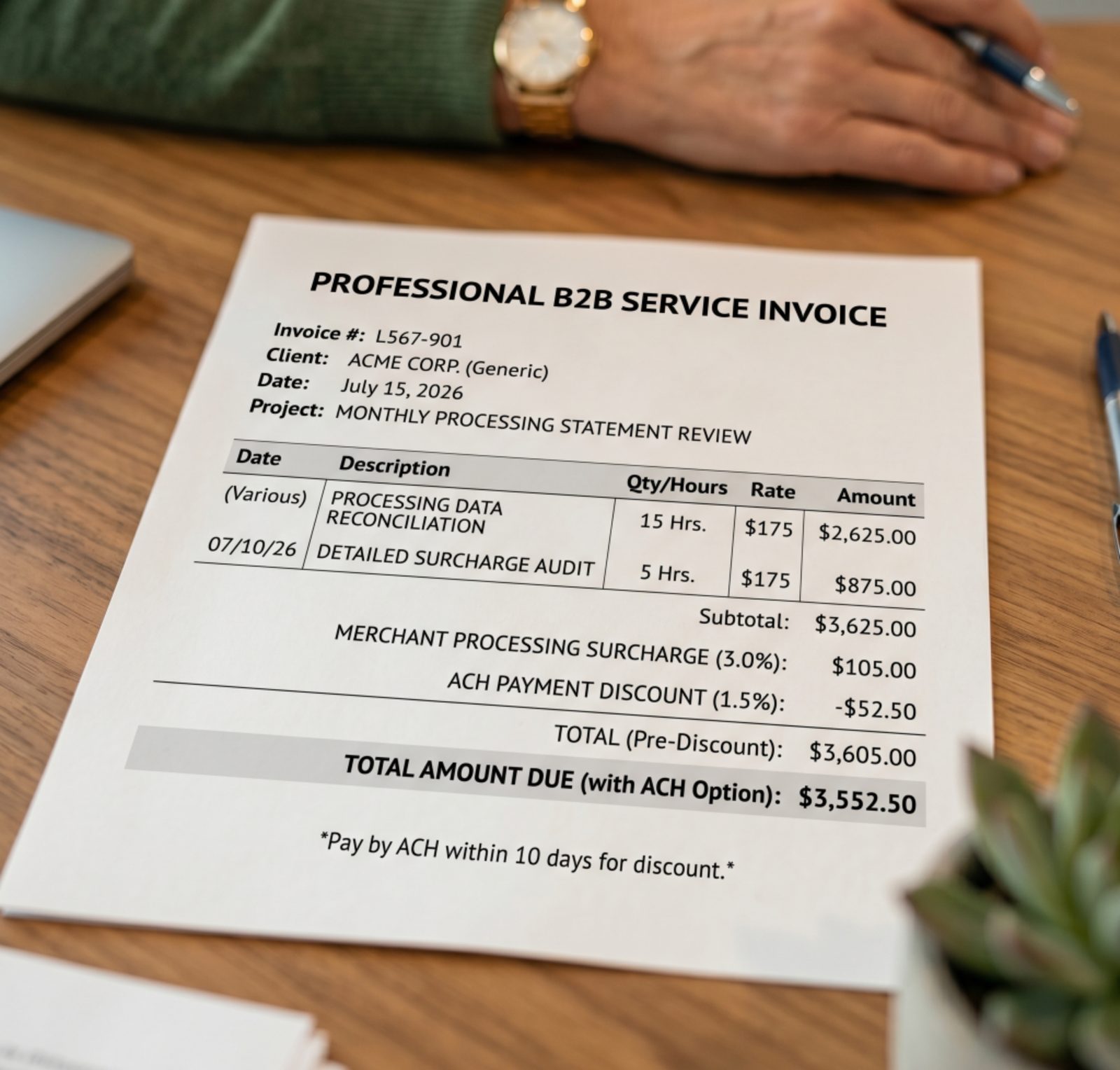
If your average transaction is $1,000, $5,000, or $20,000 — the math on processing fees is brutal. A single transaction can cost you $300 in fees. There's a legal, professional way to recover that cost.

Business-to-business payments have always been complex — net terms, ACH, wire transfers, corporate cards. As more B2B buyers shift to card payments for the rewards and float, sellers are absorbing fees that can run 2.5% to 3.5% on transactions that were never priced to accommodate them.
A business processing $200,000 a month in B2B card payments is paying $5,800 to $7,000 a month in fees. On a services contract or wholesale order, that 3% can wipe out a significant portion of your margin on a single deal.
Your invoice price stays the same. A 3% fee appears as a line item when clients pay by credit card. Clean, professional, and increasingly standard in B2B billing. Most business clients understand and accept it — especially when disclosed in the contract or engagement terms upfront. Works best for businesses where most clients pay by credit card.
Offer two prices: a standard price for card payments and a lower price for ACH or bank transfer. On large invoices the savings to the client are meaningful — which actually incentivizes ACH adoption, reducing your card volume and your fees simultaneously. Works best for businesses with clients open to bank transfer payments.
Not sure which fits your model — or whether a combination makes sense? That's exactly what our free analysis is for.
| Monthly Card Volume | Current Fees (at 2.9%) | Monthly Savings | Annual Savings |
|---|---|---|---|
| $75,000 | $2,175 | ~$2,066 | ~$24,790 |
| $150,000 | $4,350 | ~$4,133 | ~$49,590 |
| $250,000 | $7,250 | ~$6,888 | ~$82,650 |
| $500,000 | $14,500 | ~$13,775 | ~$165,300 |
Savings reflect ~95% recovery rate.
It depends on your contract language. Many B2B businesses add a payment terms addendum covering card fees — a simple, professional disclosure that clients sign. New contracts should include payment surcharge language from day one. We can advise on standard language during your analysis.
Corporate and purchasing cards often carry higher interchange rates than consumer cards — making the fee recovery even more valuable on those transactions. Surcharging applies to all credit card types including corporate cards.
Most major accounting and invoicing platforms support surcharge line items. QuickBooks, FreshBooks, and similar platforms have either built-in surcharge features or simple workarounds. We'll confirm your specific setup during the analysis.
30-day processor notice, debit card exclusion, and 3% cap — all handled as part of your onboarding. For businesses with high ACH volume, dual pricing between ACH and card carries no surcharge regulations at all — it's simply a discount for a preferred payment method. Clean, compliant, and built for how B2B businesses actually operate.
Large tickets, contract billing, mixed payment methods, client relationship sensitivity — we've worked with B2B operations across industries and we know the nuances. When you reach out, you talk to George — someone who will give you a thorough, honest assessment of what makes sense for your specific business model and flag anything that needs attention before you go live.
We process about $300,000 a month in card payments from clients. George set us up with surcharging and we recovered nearly $8,000 a month in fees we'd just been absorbing for years.
We switched our contracts to include surcharge language and added ACH as a discounted option. Most clients switched to ACH on their own. Our card volume dropped and our margins went up.
Free analysis. Real numbers. No obligation. If it's not the right fit we'll tell you straight.
Ready to move forward?